
FEATURED
Hewing a Legacy: the Story of Pollok, Gilmour and Company
In Andrew Gibb’s story of Glasgow, he mentions that by 1840 Pollock (or Pollok), Gilmour and Company became the largest timber importing business in the world. This set me off on some background research on the story of the founders of this timber dynasty from Glasgow’s Southside.
The River Clyde has long been an artery of industry with its banks echoing with the sounds of shipbuilding and global trade. Instrumental to this powerhouse of commerce were the timber merchants who supplied the raw materials for countless vessels and construction projects. Among the most prominent of these was Pollok Gilmour and Company, a name that by the early 19th century had become synonymous with the transatlantic timber trade.
From Glasgow to the forests of North America
Pollok, Gilmour & Co. was established in Glasgow in 1804 by Allan Gilmour Senior (1781-1849) and the brothers John (1778-1858) and Arthur Pollok (1775-1849). The partners had met as pupils of the Parish School at the Mearns (later, Newton Mearns) to the south of Glasgow.
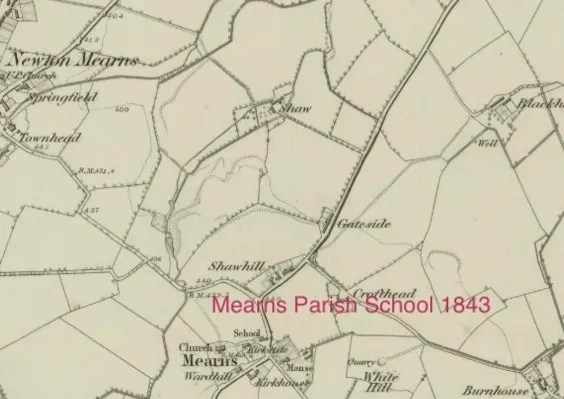

This firm embarked on a journey that would see it rise to become a dominant force in the global timber industry. Initially, their focus was on importing timber from the Baltic regions. However, the Napoleonic Wars and the Continental System also known as the Continental Blockade, was an embargo implemented by Napoleon I of France, aimed at crippling the British economy by cutting off all trade between Britain and continental Europe. This system was enforced through decrees like the Berlin Decree (1806) and the Milan Decree (1807). It consequently disrupted traditional European timber supplies to Britain.
It was this challenge that propelled Pollok, Gilmour and Company towards the vast, untapped forests of what was then British North America. Allan Gilmour was instrumental in this expansion, establishing crucial branches and operations, particularly in New Brunswick (Miramichi and Saint John) and Quebec. These weren’t just trading posts; the company invested heavily in sawmills, shipbuilding yards, and the extensive infrastructure needed to fell, process, and transport timber.
A timber empire takes shape
By the 1830s, Pollock, Gilmour and Company was a colossal enterprise. It reportedly operated over 130 vessels, making it one of the largest ship owning firms in Britain at the time. The scale of their operations was staggering, employing an estimated 15,000 men across their sawmills, wharves, and logging camps, utilizing thousands of horses and oxen. The firm was shipping hundreds of cargoes of timber annually, fuelling Britain’s industrial growth and construction boom.
The company’s influence extended beyond mere resource extraction. They were involved in shipbuilding, constructing vessels to carry their timber back to the Clyde and other ports.

Key figures like Alexander Rankin, (1788-1852), a nephew of the Pollok brothers, joined the firm in 1806 and played a vital role in managing the burgeoning North American operations. The company’s structure often involved establishing ‘foreign houses’ as separate partnerships, a measure likely taken to manage liability across their sprawling interests.
Evolution and restructuring
Like all enterprises, Pollok, Gilmour and Company faced its share of internal developments. A dispute among the founding partners led to a significant restructuring and the creation of several new enterprises. All of them linked by close family relationships.
Robert Rankin (1801-70) brother of Alexander joined Pollok, Gilmour and Company in 1815. In 1822 he set up a branch firm, Robert Rankin and Company, in Saint John, New Brunswick. This branch became the most prosperous and successful of the Pollok, Gilmour, and Company enterprises. In 1838 he returned to Scotland to lead the reorganisation of Pollok, Gilmour, and Company. He renamed it Rankin, Gilmour, and Company, and moved the headquarters to Liverpool. He established branch offices in New Orleans and Mobile, Alabama, to counter winter downturns through cotton trading.


Meantime Allan Gilmour Senior’s nephew, also called Allan Gilmour (1805-84), joined the business in a clerk’s position in 1819, rapidly securing promotion to the booming Miramichi branch. A Montreal branch was established in 1828 with his cousin William Ritchie (1804-56) trading as William Ritchie and Company. It was a general mercantile firm which bought square timber and deals and shipped supplies to lumber camps in the Ottawa valley.
By 1850’s Robert Rankin was trading wooden sailing ships from Liverpool to North America and the extent of his involvement in shipping is shown by his appointment as Chairman of the Mersey Docks and Harbour Board in 1862/63.
Rankin then entered a partnership with Allan Gilmour and formed Rankin, Gilmour & Company. By 1880 they were trading six iron sailing ships with Saint names from their office in South John Street, Liverpool along with the composite half-wooden half-iron Duke of Edinburgh to North America.
The Pollok brothers retired from the business around 1853, and the original Glasgow-focused Pollok, Gilmour and Company continued in its evolution. The name ‘Pollok, Gilmour & Company’ itself appears to have been formally dissolved around December 1872, marking the end of an era for this iteration of the firm.
A lasting imprint
Pollok, Gilmour and Company may have ceased operations in the latter part of 19th century but its story typifies the entrepreneurial spirit, global reach and transformative power of Glasgow’s Victorian industries. Its operations not only shaped landscapes on both sides of the Atlantic but also laid the groundwork for future enterprises. A descendant firm Gilmour & Aitken was established in 1852 and continues to trade in timber from its base in Jamestown, Alexandria, 15 miles from the centre of Glasgow and where it all began. The founders lie interred in the Mearns Kirkyard close to the old Parish School where they had met.
By Graeme Boyle
Published 28th January 2026
Republished from walktalktours.uk
Sources
https://web.lib.unb.ca/archives/finding/gr/description.html
https://electricscotland.com/history/pollock/index.htm
http://gdl.cdlr.strath.ac.uk/mlemen/mlemen075.htm
https://www.biographi.ca/en/bio/gilmour_allan_1775_1849_7E.html
http://www.glasgowwestaddress.co.uk/100_Glasgow_Men/Pollok_Arthur.htm
https://graveyard.mearnskirk.church/Monument/Details/Z02
https://www.biographi.ca/en/bio/gilmour_john_10E.html?print=1
https://collections.st-andrews.ac.uk/series/papers-relating-to-canada/2063462
https://www.facebook.com/groups/545702595578151/posts/3036686576479728/
https://miller.familygenes.ca/getperson.php?personID=I40361&tree=T3
no replies