
FEATURED
Mount Florida’s evolution and how Hampden got its name
Our previous blog of 2025 revisited the origins of the name ‘Mount Florida’ in Glasgow’s Southside. This time around, we’ll consider how Mount Florida grew in the late 1800s and early 1900s to become the suburb we know today.
Most of the land that was later developed into tenements was part of Clincart farm.
The image below from the early 1900s shows what still remained of the farm site at the time. You can see Mount Florida Church to the left hand side.

The two-storey farmhouse survived from the 1830’s to later serve as a pavilion and dressing rooms for ‘Lesser Hampden’, part of Queen’s Park Football Club, from the 1920s until 2013 when it was closed for safety reasons and then demolished in 2022.
The original photograph would have been taken from the upper levels of a newly-built tenement on Cathcart Road. It dates from early 1900s. Some of the development of tenements locally was in the early 1900s when Clincart still clearly was a working farm.
By the 1870s, when some of the earliest tenement development was beginning, there were already a few villas built. In addition to ‘Mount Floridon’ which by then was a ruin, there were Eildon Villas and May Terrace.
In the 1870s, new tenements were built on Maggie’s hill. This was a nickname given to an area we now know as Hampden Terrace.
These grand tenement homes were built by local builders the Eadie brothers.
The name Hampden comes from the clubs that were set up to encourage parliamentary reform, which, in turn, were inspired by John Hampden who was a Parliamentary reformer in the 17th Century
In 1637, he stood trial for refusing to pay ‘Ship Money’, a tax levied by the Monarch on the people without Parliament’s consent, to build his Royal Navy. John Hampden became a national hero for standing up to King Charles I.
The grand tenements of Hampden Terrace were home to Alexander Eadie. He lived at 3 Hampden Place (997 Cathcart Rd). George Eadie lived at May Terrace at Hampden Park villa. This was destroyed by fire in the 1940s.
The Eadie brothers were also involved in forming Queen’s Park Football Club, and when the first clubhouse was built in 1873, the committee chose to to name it “Hampden” after the Terrace.
Another notable building of this period was the Deaf and Dumb Institute built in 1868.

Glasgow’s Deaf and Dumb Institution relocated from Barony Glebe in Townhead to new custom-built premises at Mount Florida in 1868. The new building in Prospecthill Road was designed in the Venetian style by local architects, Salmon, Son & Ritchie. It was formally opened on 22nd May 1868 by Glasgow’s Lord Provost, Sir James Lumsden.
The Institution became part of Langside College in 1947 and in 2002 it was converted for residential use as the ‘Chroma Building’.
By the late 1800s and early years of the 20th century as Mount Florida was going through a boom of tenement development it was still part of Cathcart parish.

Between 1907 and 1912 this building above served as the Cathcart council chambers. It is now a doctors’ surgery and health centre. During this period, new tenements appeared across new streets such as Stanmore Rd and Bolton Drive and the Primary school was built in 1897 to accommodate the growing population.
By the time tram lines reached ‘the Mount’ in 1902, the building of tenements was underway and continued until the 1920s, and Mount Florida took on the shape we know today. This map from 1913 shows the new street layout being developed.

Bolivar Terrace highlighted above was originally Montgomerie Terrace but the name was changed by the City of Glasgow Council in 1933 to celebrate the 150th Anniversary of the death of Simon Bolivar in 1783. Next time you are walking nearby, have a look for the plaque below.

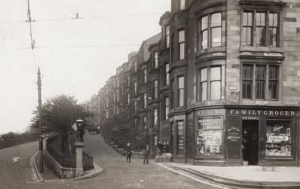
The image below from the early 1900s will be recognisable to many, with the tenements as they are still today. Moreover, while the legendary Glasgow trams are long gone from the junction of Cathcart Road and Clincart Road, the ‘Mount’ still retains much of its original charm and history.

Read the previous blog: How did Mount Florida get its name?
—
by Dougie McLellan
Published 29th October 2026
Great taster of history for the neighborhood! Was the original mt floridon anything to do with Florida water and healthful associations?
I have a house brick with eadies patent hangingshaw stamped on it,could it be the same family
Good spot, looks like you are correct! George & Alexander were wrights and builders, brickmakers and quarrymasters at Linn Quarry. Details at the great Scottish Brick History site, https://www.scottishbrickhistory.co.uk/hangingshaw-brickworks-cathcart-glasgow/
I think you are aware of this, as your Eadie bricks are registered there already, I note!